
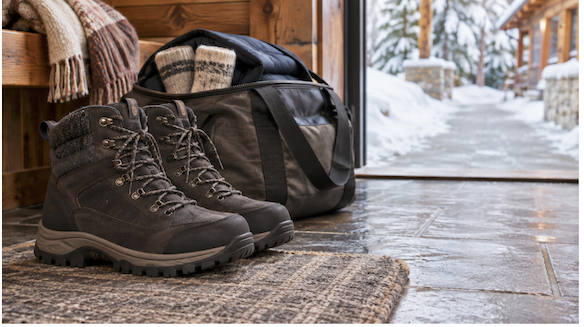
You step out into the cold air at your destination and find your toes are cramped, dragging or slipping.
Obviously, you want a pair of boots that will cope with all the walking you plan to do, bag carrying, wet and slushy surfaces and varying temperatures without leaving your feet aching with pain
There are quite a few considerations when deciding which pair to buy to cope with all aspects of your holiday.
What You’ll Learn
- Considerations depending on type of holiday
- How to determine the correct size
- Adequate support
- Insulation, waterproofing and soles
- Tips when traveling
- Final thoughts
Considerations depending on type of holiday
It goes without saying that you should consider how much time you expect to spend out in the snow, and on what kind of surfaces.
- For city breaks, you’ll probably spend more time on cleared pavement than on trails. Look for a sole that feels steady on hard ground, a boot that isn’t awkward on stairs, and enough insulation for time spent waiting outdoors.
- If you expect to be wading through snow, slush or rugged paths, a taller boot with water-resistant or waterproof construction and a protective lower section becomes more useful. Avoid low-cut, lightweight options that are only suitable for short trips to and from a vehicle.
- How much time do you expect to spend indoors? Heavy snow boots may be useful outdoors but tiring in museums, restaurants, or heated stations. So you may want a pair of lighter footwear for these occasions.
Also, be sure to look at expected temperatures for the full duration of your stay.
How to determine the correct size
Don’t assume your winter boots will be the same size as, for example, your running shoes. Here are some tips for finding the right size of winter boots:
- measure both your left and right feet, and fit to the larger one
- feet tend to expand over the course of a day, so it’s best to try shoes on towards the evening
- try the boots on with the type of socks you will be wearing with them
With any of these warm men’s winter boots, you should pay particular attention to the amount of excess space over the length of the toes, and to how snugly the heel sits in the boot.
Ideally, with both feet standing flat on the ground:
- you should be able to wiggle all your toes comfortably and with some space to the sides;
- once laced to satisfaction, your heel should sit nicely with no excessive pressure over the top of the foot;
- if safe, walk down a gentle ramp or a few steps to ensure your foot does not move forwards excessively;
- once you have walked around for a while, re-assess the points above, and ensure there are no areas of discomfort.
Wearing thicker socks than normal may well be desirable, but you shouldn’t necessarily add a whole extra size to accommodate this, as there may then be too much excess room.
Alternatively, if there’s too little space, you risk compressing your socks and restricting the ability to move your toes.
So if the boots are too tight in any area, it may be worthwhile trying wider versions or other styles before increasing the overall length of the boot.
Adequate support
Many pairs can seem very plush when you first try them on, but may lack sufficient support once you’ve covered a few miles.
So continue to assess after a substantial period of walking around.
- Ensure the heel remains snugly enclosed and doesn’t lift excessively as you walk. Ideally, with several laces running up the length of the boot, you can adjust the amount of snugness around this area.
- Assess the insole. Adequate arch support is desirable, and your foot shouldn’t droop excessively to either side. If you wish to insert your own insoles, ensure the existing one can be easily removed and there is sufficient depth.
- Obviously, having more coverage above the ankle can help support and protect the foot, provided it fits well around that area.
You should also try walking and turning, checking that the boot bends at the ball of the foot without twisting loosely through the middle. Ideally, it shouldn’t affect your gait at all.
Insulation, waterproofing and soles
There is a temptation to go for as much insulation as possible. However, this will likely lead to overheating as you make your way around town or between attractions.
There are a number of elements to consider to ensure you’re protected from the elements:
- sufficient insulation to keep feet warm when stationary or moving slowly, but again not so much as to prevent adequate room for toes
- a good degree of waterproofing, particularly around the lower half of the boot to protect from deep, wet snow. Wearing appropriate socks that remove sweat will also assist
- a good depth and pattern to the tread to provide better grip on winter surfaces
But no sole makes icy ground completely safe.
Slow down on polished ice and watch for hidden slippery patches near curbs and entrances. If your trip includes extended icy walks, it may be beneficial to have some form of attachments, preferably removable once you reach your destination.
Tips when traveling
It’s preferable to have had a few occasions to try the boots around the house and, ideally, one extended period of walking around before you embark on a big trip.
Identify any problem areas and don’t assume they can just be fixed by breaking in the boot.
The materials may well become more supple with time, but this will be of little use if, for example, the toe box is slightly short. So it’s better to replace it with another style or pair if necessary.
Other things to bear in mind:
- Take plenty of spare socks, particularly if it has been wet or you’ve been on your feet a lot
- Leave room for drying. Remove damp insoles when the design allows, open the boots, and let them air-dry away from direct high heat.
- Luggage space: you may want to wear the boots to and from your destination or take a separate small bag to place them in once dirty
- A second option: you may want a lighter pair to change into for parts of your day and give your feet a rest.
If arriving directly into snowy conditions, you may wish to have the winter boots easily accessible. It may not be ideal to have to search for them at the bottom of a suitcase!
One final point: make sure your trousers sit well over them without bunching or dragging.
Final thoughts
Ideally, once settled and walking around, you want to forget about your footwear. There’s nothing worse than constantly re-adjusting the laces due to a loose heel, cramped toes, or having to stop to remove built-up snow from around the top.
So take the time to assess which boots are best suited to your route and conditions, make sure they fit well (with appropriate socks), and give them a good try-out before traveling.
A little preparation beats dealing with uncomfortable feet halfway through a winter trip.
Leave a Reply