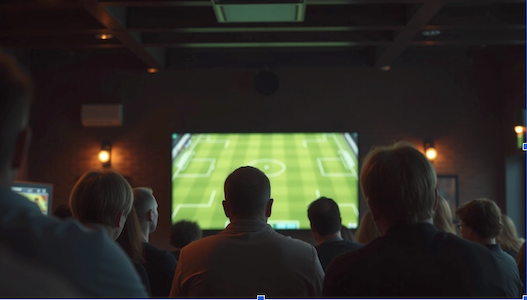
On Sunday the World Cup ends at MetLife Stadium in East Rutherford, and while about eighty thousand people will be inside the building, the far bigger crowd is the one that has spent five weeks on a bar stool. Owners have known for years that a summer tournament is the best stretch of the four-year cycle. What is new in 2026 is how many of the people at the rail are watching with money on the match, and how openly the venues around them have started to build for it.
For a long time the bet was a private thing, a paper slip or a quiet tap on a phone under the table. That has flipped. Nightlife operators now treat wagering as part of the reason a customer picks their room over the couch, and a fair number of bars have leaned into it deliberately, from screens tuned to live odds to staff who know which app works where. None of that changes the underlying rule, which is that legal online sports betting in the United States is set state by state rather than nationally. Before you assume your account travels, a running state-by-state check like the Bonus.com sportsbook coverage is a steadier guide than whatever the person two stools down swears is legal in the city you flew into. Real-money play is 21 and over wherever it is permitted.
Why The World Cup Turned Bars Into Betting Rooms
A month-long, 104-match tournament across sixteen host cities is a betting event in a way a single Sunday of football is not. There is always another game, always another market, and the matches land at hours when people are out of the house anyway. A weekday afternoon kickoff pulls a crowd that would not gather for a routine fixture, and a chunk of that crowd arrives already logged in.
The result is a room with a second layer of noise running underneath the first. Someone cheers a meaningless corner in the 87th minute while everyone else stares, because that corner moved a live market. A groan goes up in one booth over a yellow card that changed nothing about the score. For a venue, that energy is the product. People are not paying eleven dollars for a beer to watch a match they could stream for free on their phone. They are paying for the reaction of forty other people, and a shared stake sharpens that reaction in a way a living room cannot manufacture.
What “Leaning In” Actually Looks Like
The phrase covers a range. At the lighter end, a bar simply stops pretending the betting is not happening. It puts a screen on live scores and odds, it runs bracket-style pools that stay on the right side of local law, and it trains bartenders to answer the one question everyone asks, which is whether a given app even works in that state.
At the heavier end, venues chase formal tie-ins. Some operators in states with legal mobile wagering have struck promotional deals with sportsbooks, hosting branded viewing nights or handing out sign-up credit. Those arrangements are only available where the state has authorized online sports betting in the first place, and they come with advertising rules that vary by jurisdiction. A bar in a state with no legal mobile market cannot run the same night, no matter how many customers ask for it.
The Legal Picture Travelers Get Wrong
This is the part that trips up anyone following the tournament from city to city. Legal sports betting in the US is not a single national permission. As of mid-2026, some form of it is legal in roughly three dozen states plus Washington DC, but the number that allow full online and mobile wagering is meaningfully smaller, and different trackers count the field differently because retail-only states and states mid-rollout muddy the total.
Utah and Hawaii allow none at all. Texas has not legalized it. An app that takes your wager without complaint in New Jersey will refuse the moment your phone crosses into a state that has not authorized online play, and sitting inside a packed bar full of people betting does not override that. The apps use location checks at the point of the wager, so the relevant question is never “is betting legal in America,” it is “is online betting legal in the exact state I am standing in right now.” Assume nothing about your account traveling with you.
A Bar Is Not A Big Outdoor Screen, And Betting Is Part Of Why
There is a reason the serious watching happens indoors. A tight room reacts as one animal, close enough that a near miss produces a single collective groan instead of a delayed wave rolling across a plaza. That argument is exactly why this site has long made the case that the best World Cup atmosphere lives in bars rather than at public watch parties, and the betting layer only pushes it further in that direction.
A live market rewards attention to detail, and detail is easier to follow when everyone is looking at the same screen from more or less the same angle. In a plaza with a few thousand people spread across a lawn, the odds ticking on your phone are a solo experience. In a bar, the person next to you is on the same line, reacting to the same swing, and the room turns a private wager into a public event. That is the atmosphere a venue is actually selling, and it does not survive being spread thin across an open field.
What The Room Costs A Venue To Run
Being the bar with the game on is not free, and once you add betting-adjacent extras the bill climbs. Commercial broadcast rights are a separate product from the home package, priced by venue and enforced seriously, and the promotional side carries its own compliance work. Here is how the main sports occasions stack up for an operator.
| Sports occasion | Why the room fills | What the venue is buying | The catch |
|---|---|---|---|
| 2026 World Cup, weekday afternoons | Games land during work hours and pull a betting-heavy crowd | Standard commercial sports tier, plus staff on an unusual shift | Five weeks every four years, then nothing |
| NFL Sunday afternoons | Out-of-market fans and heavy in-play betting | NFL Sunday Ticket for business, now sold through EverPass for 2026 after DirecTV’s long run ended | Streaming means new hardware and better internet, put by some operators in the tens of thousands per location |
| College football Saturdays | Alumni turnout, plus point-spread interest | A wide cable and streaming spread to catch every conference | All-day staffing for a crowd that arrives at noon |
| March Madness, first two days | Weekday afternoon games and bracket season | Basic commercial cable is usually enough | Two huge days, then a long quiet tail |
| Big fight nights | A one-off event people plan an evening around | Commercial pay-per-view, priced per venue and audited | You eat the cost if it ends in ninety seconds |
The NFL line is the live problem right now. Starting with the 2026 season, DirecTV no longer carries Sunday Ticket for commercial venues, ending a relationship that ran back to the package’s launch in 1994. EverPass, backed by the league, is now the exclusive route for bars and restaurants, delivered over streaming rather than a dish. The National Restaurant Association has publicly asked for more time, because moving from satellite to streaming is not a swapped box, it is faster internet, new switching gear, and rewiring, which some operators have estimated at 30,000 to 40,000 dollars per location.
Responsible Betting Is A House Rule Now, Not A Poster
The venues doing this well treat the wagering as something to manage, not just monetize. A bar that leans into betting also tends to lean into the guardrails, because a customer who blows a night’s money in the second half is not coming back and is not fun to be around in the meantime.
That means bartenders trained the same way they are trained on alcohol service, watching for the person chasing losses instead of the person who has had one too many. It means posting the helpline number where the odds screen is, and it means being honest that a wager does not make anyone better at watching. Sportsbooks build in a margin the same way a casino keeps a house edge, and no amount of confidence at the rail changes the math. The bet makes you louder about a corner kick. It does not make you right about one.
The Calendar After Sunday
Once the trophy is lifted, American bars fall off a cliff for about six weeks. Baseball is on but few people watch it in a bar with the sound up, and preseason football is a rumor. The betting spike fades with the crowd, because a World Cup is about as communal as a betting event gets and the routine calendar cannot match it.
Then it starts again. College football in late August, the NFL in September, and a fall schedule that in most of the country is the real backbone of a sports bar’s year. The open question for operators who invested in the betting angle this summer is whether the same room shows up for a Week 6 afternoon. Communal, high-stakes events like a World Cup final always draw the biggest out-of-home audiences. Whether a routine Sunday carries the lift is exactly what every venue with a new streaming invoice on the desk is now trying to work out.
What The Numbers Do And Do Not Show
Part of why bars feel emboldened to build for this is that the audience is finally being measured. Nielsen’s announcement that its out-of-home measurement now spans the entire contiguous United States meant that, for the first time, the crowd at the rail counted in the national figure a network sells against. This was the first World Cup measured that way from start to finish, and out-of-home viewing has run at roughly a quarter of each network’s total across the tournament, pushing toward 40 percent on some matches.
What the meter cannot see is the betting slip. It registers whether a broadcast was playing nearby, not whether the person under it had a stake on the result or was chasing a loss. The measurement change ended a thirty-year argument about whether bar crowds exist. It says nothing about how those crowds should be handled once a sportsbook is part of the night, and that judgment still sits with the operator, the bartender, and the person deciding how much to put on a group-stage match.
Frequently Asked Questions
Can I use my sports betting app in any bar during the World Cup?
No. Legal online sports betting in the US is set state by state, and as of mid-2026 some form of betting is legal in roughly three dozen states plus Washington DC, with a smaller number allowing full online and mobile wagering. Utah and Hawaii allow none, and Texas has not legalized it. Apps run a location check at the moment of the wager and will refuse outside an authorized state, so being inside a busy bar changes nothing. Real-money play is 21 and over.
Why are nightlife venues leaning into sportsbooks this year specifically?
A 104-match tournament spread over five weeks gives a room a constant stream of games and markets at hours when people are already out, which is a stronger draw than a single weekly fixture. Venues in states with legal mobile betting have found that a crowd with a stake reacts harder and stays longer, so many now build for it with live-odds screens, pools, and, where the law allows, promotional tie-ins with licensed sportsbooks.
Is betting in a bar safer or riskier than betting at home?
Neither by default, but a good venue adds friction that a phone at home does not. Bars that lean into wagering tend to train staff to spot someone chasing losses, post helpline information, and keep the mood social rather than desperate. The odds are the same either way. A sportsbook builds in a margin the way a casino keeps a house edge, and no run of confidence at the rail overcomes it.
How much of the World Cup crowd is actually betting?
There is no clean national figure, and anyone quoting a precise share is guessing. Nielsen now measures the size of the out-of-home audience, which has run at roughly a quarter of each network’s total across the 2026 tournament, but its meters cannot tell who had money on the match. What venues report is anecdotal: a visibly larger slice of the room reacting to live markets than in past cycles.
Do bars need a special license to show betting-related content?
Showing live odds or scores is generally not the issue. The commercial broadcast rights to the games are the licensed part, priced by venue and enforced. Formal promotions with a sportsbook are only available in states that have authorized online sports betting, and those deals carry advertising rules that differ by jurisdiction, so what a bar can legally run in one state may be off limits a border away.
Leave a Reply