Despite World Cup 2026 Upon Us, Here’s Why Soccer remains a second-tier sport in America
By Kevin Wilkerson, PubClub.com Sports Editor
The World Cup is one of the world’s greatest sports spectacles. Soccer is not.
First, the World Cup. From this American’s armchair, it’s the rest of the planet’s version of college football – intense, emotional and a can’t-lose-more-than-once (then not at all as it progresses) situation.
There is tradition, controversy, even legendary plays – the “hand of God” lives forever in World Cup lore. And extremely questionable officiating.
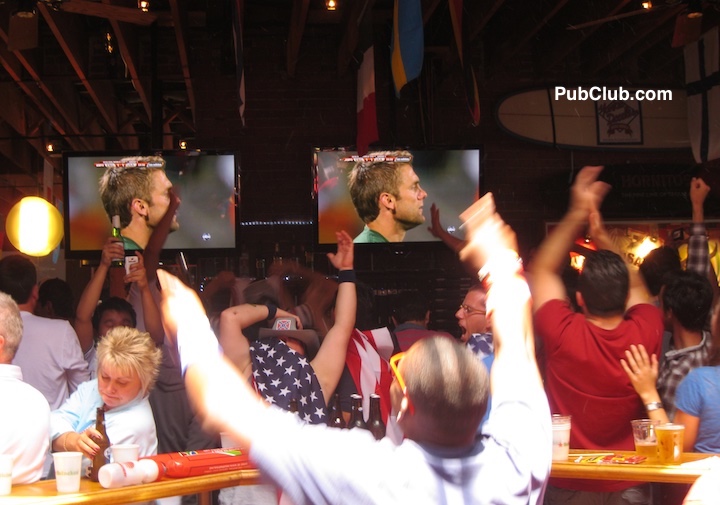
Fans dress in their country’s colors, paint their faces, sing fight songs and tailgate before and after games. Any American used to Saturday afternoons at The Grove in Oxford, Miss., The World’s Largest Outdoor Cocktail Party in Jacksonville, FL.; or the “backstop” at the Rose Bowl before USC-UCLA, should absolutely love the World Cup atmosphere.
The skill level of the players is amazing. How they can maneuver that ball through a crowd of defenders using nothing but their feet is an amazing feat. The spins on kicks are like fades and draws from a pro golfer.
In one amazing moment in one World Cup, an Argentina player stopped a ball with his chest and knocked it to his foot and then into the goal in a single motion – after playing for nearly 100 minutes, no less. It’s one of the most mesmerizing athletic feats of all time, almost right up there with Michael Jordan’s mid-air hand switch in the NBA Finals against the Lakers for the Bulls’ first championship.
And, of particular note, there’s virtually no hot-dogging or “me me” actions by the players. This is a team game, a welcome relief after seeing the chest-thumping and touchdown celebrations far too prevalent in American professional sports. Heck, they even penalize players for arguing with the refs.
For these reasons, I enjoy watching the World Cup. So much so that when Mexico or a Latin American team play, I tune into Univision, the national Hispanic network. The announcers are so much emotional than on Fox and it’s much more exciting to watch.
So why can’t Americans embrace the World Cup and soccer in particular? Here are the main reasons why this is the case:
• America is, for the most part, a stick-and-ball country.
• Soccer is played only with the feet. Americans excel at hand-to-eye coordination, so it stands to reason if you take away the hands, you take away the coordination.
• Like the Olympics, the World Cup comes only once ever four years.
• Unlike the Olympics, the World Cup has no “chick sports” like figure skating to draw in the female audience. What TV should do instead is show more than the game – hot girls in the crowd, the party beforehand, groups of fans at the bars and places about town and the emotions surrounding events, thereby creating a “I wish I was there” atmosphere. (This approach should be applied to ALL sports, by the way.)
Soccer as a Game
Soccer needs more of this: not scoring but shots on the goal.
Here are soccer’s biggest battles for popularity in the USA, and they are not head-knockers:
• It’s not on TV. If Americans don’t see a sport on TV on a regular basis well, it pretty much doesn’t exist.
• There’s no particular region in which it’s popular. Soccer is undeniably huge among the Hispanic community – just watch Deportes during the nightly newscasts on your local Hispanic station and about all you’ll see are soccer highlights – but not elsewhere. Hockey has the upper East Coast, NASCAR has the South (while it has grown to be popular elsewhere it’s still biggest there), college football is huge in the South and Midwest and pro football is strongest on the East Coast and in Texas. Even beach volleyball has Southern California. Where is soccer’s regional pull? Nowhere.
But the main problem with soccer and why it will never catch on in America is the game itself.
Here’s the reasons for that statement:
• They pass the ball backward too much. That’s it in a nutshell. “Experts” can argue about a lack of scoring but the real issue is the lack of attempting to score. Americans are used to going forward in sports, to attack the basket or go for the end zone. Even Woody Hayes’ old “three yards and a cloud of dust” offense was designed to move the ball forward.
In soccer, it’s a pass backward here, another pass backward there, then another, and so on. “Boring!” Americans say. In three games in World Cup ’06, Team USA had exactly one goal and only two shots on goal. Think about that for a second – two shots on goal in 2 1/2 hours of play. In the final moments of the win-or-go-home game, supposed USA star Landon Donavon had nothing between him and the goal other than a falling-down goalie and a patch of grass the size of a country club fairway only to literally pass on the potential game-tying goal. One could just feel the clicks of the TV remotes. This year’s Team USA, by the way, is ranked 22nd by FIFA and has no chance of winning World Cup 2026. It’s hard for Americans to embrace a 22nd-ranked team in any sport. We like winners. Contenders.
Soccer players make more passes than Tiger Woods did in his singles days.
Surely some savvy coach can come in and apply the principals of other sports to soccer and revolutionize the game. Spread the field to create better spacing and more open lanes like a fast break in basketball. Constantly strive to get players in scoring position, then go for the big hit, as in baseball. Overload one side of the field and run the equivalent of a power sweep, or suddenly swing the ball back to the weak side as in football.
And shoot, shoot, shoot. Eventually the defense will fold and the goalie will wear down. Our national soccer cheer could be “Fourth quarter’s ours!”
What about attempting to block the kick from the opposing goalie before he sends it to midfield or beyond? I’m not even sure if this is legal, and have been told that it is, but blocked punts and field goals are a constant possibility in American football.
Purists will scoff at these suggestions, claiming I don’t understand “the intricacies of the sport.” That’s true to a degree, but when you are going for a mass audience you must focus on the big picture. And the big picture is that players need to shoot more and pass less.
And not only do the players run backward, but so does the clock. Rather, it runs forward, and that’s backward to Americans. Even after the game is apparently over, it continues to run. It’s interesting to note that when ESPN televised a World Cup match in ’06 there was a “time remaining” box on the screen to indicate the anticipated conclusion, while on Univision there was no such graphic. That’s a true distinction of the different expectations of the two audiences.
Hockey, by the way, suffers from the same “going backward” problem as does soccer.
So if soccer wants to go forward in the USA, it literally needs to go forward.

– FROM THE GRANDSTANDS: COMMENTS FROM SOCCER FANS –
• Liked most of your points about soccer not really breaking in (more objective than I thought it would be.) Here are what I think are the most important reasons:
1) The continuous clock- this causes:
0 No opportunity for commercial breaks during halves- making it much less attractive for TV stations depending on ad revenue. I think people end up liking sports they see on TV when they are young- if it were on TV more it would have a built-in following.
– Since its continuous and there’s no chance for resting the players (especially those not with the ball) seem to mostly move at a jogger’s pace instead of the all-out sprinting that’s American football’s strongest suit.
2) No star power on American teams. I know the US has lured both Pele and Beckham to the US but both were failed experiments. Since its a total team sport, a single player is only responsible for 1/11 of his teams success. No MLS team can afford to bring over 11 stars especially at the going rates of stars like Kaka.
In baseball, basketball, football and hockey at the highest levels in North America – they have the best players in the world in those leagues. In soccer they all play in Europe.
In other words, if you want to see the world’s best soccer players- turn on your TV at 2 in the afternoon.
30 No hands – I’ve always thought how can it be the best test of athletisism if you can’t even use half of you limbs. I think a result of this is also that most soccer players have upper bodies that look like those of marathon runners. Not the awe-inspiring muscle you expect to see on the world’s best athletes. I know they have legs like tree trunks but can’t they do a few push-ups?
40 Violence and racism that seem to follow soccer everywhere. In North American sports there may be the occasional obnoxious jerk at the game but there’s nobody rioting with police (except LA Lakers fans,) no seig-heiling and waving neo-nazi banners and nobody throwing live flares or bags of urine at the opposing goalie.
I think most parents would feel like taking there kids to a soccer game a dangerous proposition while the other four are always family-friendly.
5) Guys acting like they’re going to die on the field- and then when they see the ref won’t call anything they get up and are fine. Americans probably have a bigger problem with this than any other aspect of soccer and it is the but of many jokes about the game. The thinking is soccer = Euro = sissy.
6) Settling a world cup final with a :Penalty” Shoot-Out? Are you kidding me?! The world’s “greatest sporting spectacle” decided with a glorified game of rock-paper-scissors?!
Agree or disagree? Will soccer ever become one of America’s top sports? Leave a comment and tell us why.
If You Enjoyed This Article You May Also Like:
• Why Even Non-Soccer Fans Should Go To World Cup Bars & Watch Parties
• Best Places To Watch The World Cup In San Diego

Kevin Wilkerson is the founder of PubClub.com, an award-winning journalist and nightlife expert who has covered sports for more than two decades. While working as a newspaper reporter, he received an Associated Press award for investigative journalism. He was at the most one of the most famous matches in World Cup history, the 1994 2-1 USA upset over Columbia at the Rose Bowl. This was the game in which Colombia defender Andrés Escobar accidentally kicked the ball into his team’s own goal and where a pregame encounter involving a his friend’s joking comment about “drug lords” later became part of the game’s folklore. Wilkerson also played a little soccer in college.
Leave a Reply